
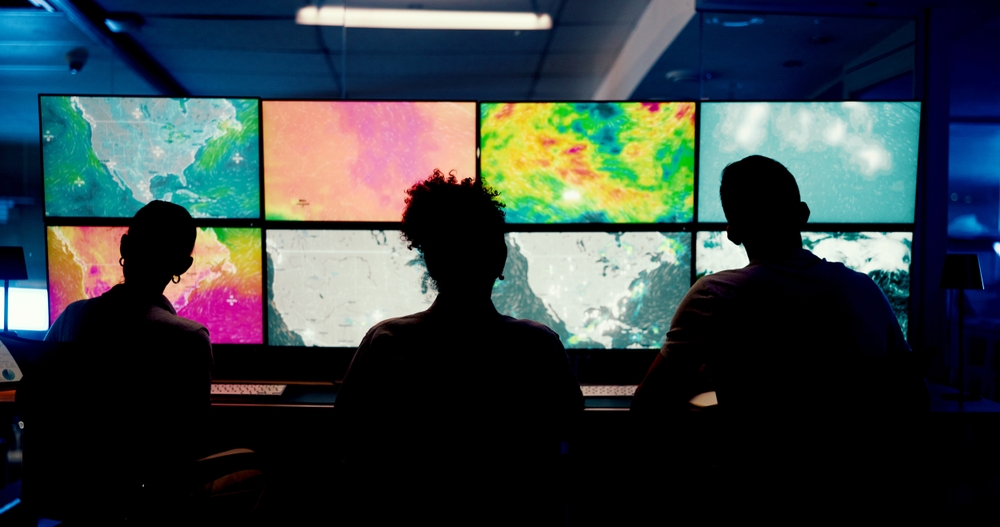
While state governments and local meteorologists are often responsible for day-to-day weather reports and emergency planning, they depend on federal employees to help inform and protect the public. These employees include researchers who provide data for weather reports and historical climate patterns and analysts who work to mitigate disaster risks. When disasters occur, federal employees work with state and local responders to save lives and provide communities with targeted disaster assistance.
By the numbers
The National Weather Service operates more than 140 forecasting and environmental prediction offices around the country. These offices focus on weather prediction, environmental modeling, space weather alerts and more. NWS collects and analyzes over 6.3 billion observations per day and releases 1.5 million forecasts and 50,000 warnings each year.
FEMA cut on-call staff that provide the agency with surge capacity to rapidly respond as disaster situations emerge.
Staffing shortages at NOAA potentially caused delayed warnings and slowed the collection of key data needed to forecast several recent tornado events.
FEMA’s backlog of funds owed to communities for disaster recovery and resiliency programs grew to $10 billion due to a delay in funding dispersals.
Profile · On the Ground
Alaska Climate Specialist at the Alaska Center for Climate Assessment and Preparedness
Fairbanks, Alaska
Rick Thoman has worked in weather and climate for more than 40 years, including in his current position as a climate specialist at the Alaska Center for Climate Assessment and Preparedness, which works to strengthen climate resilience in Alaskan communities. Thoman’s communication efforts between local tribes, communities and climate experts is a vital part of this mission.
The center’s operations rely on daily launches by the federal government of nationwide weather balloons that measure atmospheric conditions to forecast weather. However, recent staff reductions at the National Oceanic and Atmospheric Administration have complicated Thoman’s work and hamstrung the response to Typhoon Halong, one of the worst storms in Alaska’s history.
“Alaska has been especially hard hit with loss of people from NOAA,” said Thoman. “All of [them] had decades of experience in the agency.”
Since the beginning of fiscal 2025, NOAA has lost over 2,500 federal workers due to workforce reductions. Those losses meant that more than half of normally scheduled weather balloons were not launched in western Alaska. As a result, low-lying rural communities already prone to flooding and requiring alternative evacuation methods were not warned about the impending storm. Across Alaska, over 1,500 people have been displaced and are facing long-term impacts due to Typhoon Halong.
This failure of federal support is not isolated to Alaska, according to Thoman. “While this loss of upper-air observations has the most immediate impact in Alaska,” he said, “this affects weather models around the world every day.”
Other states across the country are experiencing similar chaos, including an outbreak of five tornadoes across the Kansas City, Missouri, area that injured at least three people in April 2026. Weather balloons in the region were launched five hours later than their normal schedule due to staffing shortages, resulting in a data gap that left meteorologists unable to anticipate the event.
Such a loss of capability means more than only physical devastation. Without adequate forecasting or warning systems, states are more vulnerable to greater devastation and more likely to dig out of their own economic resources or require greater federal assistance, such as from the Federal Emergency Management Agency.
While the future of NOAA is uncertain, Thoman worries that forecasting for communities across the country will continue to struggle and that the removal of career experts will also erase research that has been built over decades.
“In the short term, it means there is going to be more suffering,” he said. “In the long term, it’s just going to be that much harder.”