
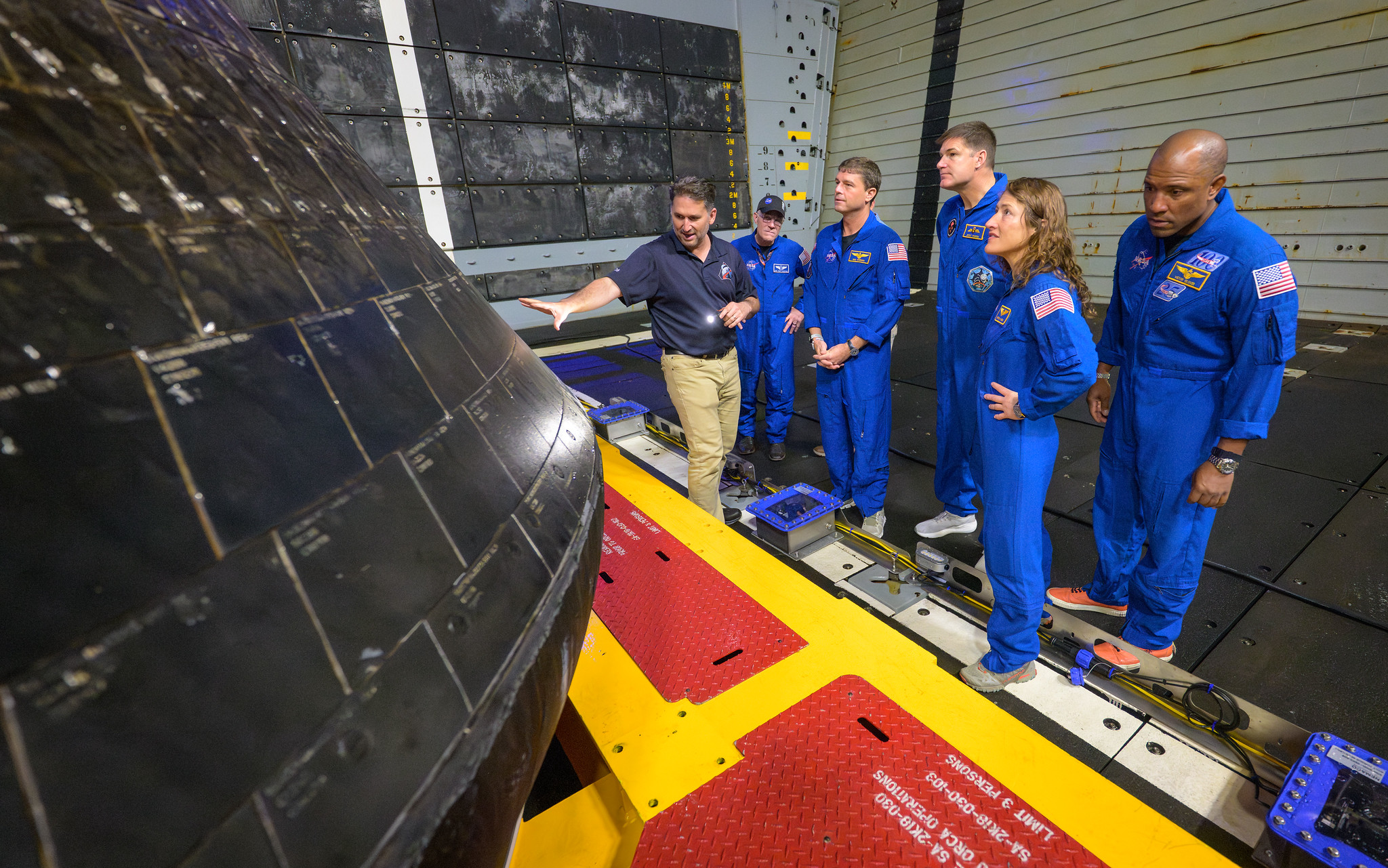
Federal employees play a key role in developing new technologies and advancing fundamental fields of science. Scientists and engineers in government set the standards that enable U.S. manufacturers to create quality industrial and scientific instruments. Funding from federal agencies sustains U.S. research and development capacity, providing early-career and teaching opportunities at many top universities. A leader in innovation, NASA has inspired generations and produced over 2,000 ‘spin-off’ technologies, from handheld vacuums to memory foam mattresses.
By the numbers
In 2025, the Cybersecurity and Infrastructure Security Agency stopped 2.62 billion malicious connections on federal civilian networks and 371 million malicious connections within essential systems like power grids and emergency response systems. That same year, CISA also triaged over 30,000 cybersecurity incidents.
All 22 scientists and engineers who sit on the board that oversees and holds the National Science Foundation to the highest scientific standard were removed.
Federal agencies have lost over 10,000 employees with STEM doctorates, including at NASA, NIST and the National Science Foundation.
Amid increased cyber threats, the Cybersecurity and Infrastructure Security Agency decreased staffing by a third and is lagging on accepting formal congressional recommendations to bolster American defense.
Profile · On the Ground
In September 2020, hospitals in the Universal Health Services network were crippled by a major cyberattack. Doctors and clinicians at UHS’ more than 250 hospitals nationwide were forced to return to pen-and-paper solutions for patient care and many nonessential procedures were canceled.
“These things could be life or death,” a UHS clinician told CBS News at the time.
In 2018, President Donald Trump signed into law legislation creating the Cybersecurity and Infrastructure Security Agency to serve as the nation’s primary cybersecurity guardian. The agency works with government and private entities to prevent, detect, issue alerts for and respond to cyberattacks.
Around the time of the UHS cyberattack, CISA issued a warning of an imminent and increased threat of ransomware to U.S. hospitals. Weeks later, CISA announced it had been responding to the SolarWinds cyberattack, a major intrusion that affected multiple federal agencies and private companies for months.
Public utilities such as power and water systems also have become increasingly exposed as countries like North Korea, China and Russia, and even Iran, have rapidly built up their cyber capabilities.
Despite all this, CISA was deeply impacted by the Trump administration’s steep cuts to the federal workforce. The agency lost about a third of its career employees between January 2025 and January 2026. Department of Homeland Security Secretary Markwayne Mullin said in May 2026 that another 1,100 employees had left amid the partial government shutdown that began in February 2026.
In the meantime, threats to key systems throughout the United States continue unabated. In April 2026, CISA sent an alert that Iran-affiliated hackers exploited hardware used in water, waste treatment and energy infrastructure. Attacks like these, if left undetected, could pose fundamental threats to the daily life of every American.
“We already had a very real and present danger that was presented by state actors compromising our infrastructure,” said Carole House, former White House National Security Council special adviser for cybersecurity and critical infrastructure policy. “So, we needed to lean in and build on. Instead, we’ve been defanging, reducing and not evolving. It’s been de-evolutionary rather than revolutionary.”